


- Quick summary
- CMP vs CMR at a glance
- What is the difference between plenum (CMP) and riser (CMR) Ethernet cable?
- What defines a plenum air-handling space?
- When is CMP plenum cable required?
- Where should you install CMR riser cable?
- Can you use plenum cable everywhere?
- Reviewing Ethernet cable quotes and installation scopes
- Recommended gear
- CMP vs CMR checklist
- FAQs
- References
This guide explains how CMP and CMR differ, how plenum spaces are classified, and what to confirm before approving a cabling quote.
Quick summary
The difference between plenum and riser Ethernet cable is the jacket fire rating, not the network speed. Under NEC usage, CMR is standard for non-plenum interior runs, while CMP is used where Ethernet enters an air-handling plenum.
- Use CMR for typical in-wall risers and non-plenum indoor pathways.
- Use CMP where the route enters a verified plenum space or the project documents require it.
- Treat Cat6 vs Cat6A and CMP vs CMR as separate decisions.
- Treat the actual HVAC path and the local AHJ as the final authority.
The sections below move from definition, to pathway classification, to quote review. If you are also comparing broader pathway choices, pair this with our Cat6 installation guide, pre-wire vs retrofit cabling guide, and network cabling quote guide.
CMP vs CMR at a glance
| Rating | Meaning | Typical use | Smoke / fire behavior | Cost / handling | Typical decision |
|---|---|---|---|---|---|
| CMP | Communications Plenum | Air-handling plenums, some commercial ceilings, some raised-floor paths | Lower-smoke, higher fire-performance standard for plenum environments | Usually more expensive | Use when the route is a verified plenum or the specification requires it. |
| CMR | Communications Riser | Vertical runs between floors, stacked closets, normal in-wall and many non-plenum interior paths | Designed to limit flame spread in risers but not for plenum air paths | Usually cheaper and easier to justify on standard indoor jobs | Use for non-plenum interior cabling unless the route or spec requires CMP. |
Under NEC hierarchy, CMP can generally be used where CMR is acceptable, but CMR cannot be substituted into a plenum path. That is a compliance rule, not a performance upgrade.
What is the difference between plenum (CMP) and riser (CMR) Ethernet cable?
Under NEC jacket ratings, the difference between CMP and CMR is fire and smoke performance, not bandwidth.
- CMP means communications plenum.
- CMR means communications riser.
Those labels do not describe category, shielding, or throughput. A Cat6 cable can be sold in either jacket rating. Leviton's current LANMARK-6 line is a useful reference because the same Cat6 family is available in both CMP and CMR variants.
CMP cable commonly uses lower-smoke fluoropolymer-based materials such as FEP, while CMR commonly uses flame-retardant PVC-based jackets. Exact compounds vary by manufacturer, but the design intent is consistent: CMP is engineered to reduce smoke in air-handling spaces, while CMR is engineered to limit flame spread in risers and walls.
That distinction matters because the safety issue is not only ignition. If a cable burns in an air-handling return path, smoke can be distributed through occupied spaces. A riser cable can still be electrically appropriate for the network and unsuitable for the pathway.
What defines a plenum air-handling space?
A plenum is a building space used to circulate environmental air for an HVAC system.
A suspended ceiling or raised floor is only a plenum when it actively serves as a return-air or supply-air path. If that cavity only contains sealed ductwork and does not itself move environmental air, it is a non-plenum space.
This route-based distinction is why ceiling type alone is not enough to choose cable. Common examples:
- Suspended ceiling used as return air: CMP may be required.
- Suspended ceiling that is just a ceiling cavity with no plenum function: CMR may still be the right answer.
- Typical single-family home wall and ceiling spaces: CMR is usually the normal indoor choice unless the route really enters a plenum condition.
This matters most in offices, schools, medical spaces, churches, retail suites, and mixed-use buildings where one ceiling zone may be ordinary and the next may tie into return-air handling. Local code officials and the Authority Having Jurisdiction (AHJ) make the final call.
A cable route above a ceiling is not automatically a plenum route. Confirm whether the space is part of the HVAC air path before specifying CMP.
Some homes use joist cavities with sheet-metal panning as cold-air returns. If Ethernet is routed through that return-air cavity, the pathway may need to be treated as a plenum even in a single-family house.
For Westchester retrofit work, this is one reason our retrofit checklist calls out plenums, rated assemblies, and route review before material ordering.
We review ceiling cavities, risers, and equipment routes so the proposal reflects the actual pathway and the appropriate jacket rating.
When is CMP plenum cable required?
CMP is required when Ethernet runs through plenum air-handling spaces or when project documents call for plenum-rated cable.
Common examples:
- a suspended commercial ceiling that serves as a return-air plenum
- a raised-floor plenum in a data or office environment
- a commercial pathway specifically called out in project specs or landlord requirements
- any route where the inspector, engineer, or building standard requires plenum rating
Leviton's current LANMARK-6 CMP product page is explicit that the cable may be installed in air-handling ducts and plenums without conduit in accordance with the National Electrical Code (NFPA 70). That is the compliance language a specifier or inspector expects to see when the route is truly plenum-rated.
Conditions that often lead to CMP specification include:
- the route is commercial rather than residential
- the building has shared HVAC return paths
- the cable crosses multiple ceiling zones with mixed pathway conditions
- the spec writer or landlord wants the simpler "all plenum in these areas" rule
Specifying engineers also sometimes standardize on CMP across an entire floorplate to reduce coordination risk in mixed ceiling zones. That can be a reasonable scope decision when route ambiguity creates more risk than the cable premium.
Where should you install CMR riser cable?
CMR is standard for non-plenum interior wall runs, vertical risers, and most single-family home Ethernet routes.
CMR is engineered to slow flame spread from floor to floor in vertical installations. Its limitation is smoke performance, which is why it is excluded from plenum air paths. Typical uses include:
- stacked closet risers
- floor-to-floor vertical runs
- ordinary in-wall office and home runs
- many commercial and residential interior pathways that never become air-handling spaces
- typical low-voltage retrofits in homes, finished basements, and utility spaces
Leviton's current LANMARK-6 riser product page lists the same Cat6 family with a CMR flame rating. It is a useful example of the underlying decision: the network category remains the same, while the jacket rating changes with the pathway.
For single-family homes, CMR is usually the indoor default because:
- most interior routes are not true plenums
- it gives a stronger indoor rating than plain CM/CMG
- it is materially less expensive than CMP
That matches the practical guidance already running through this site:
- How to wire a home for Ethernet
- Cat6 cable installation guide
- Cat6 wired network installation in Westchester
- Smart home rough-in guide
If the route stays inside normal walls, closets, soffits, and non-plenum ceiling paths, CMR is usually the answer you should expect to see on a quote.
Can you use plenum cable everywhere?
CMP can replace CMR under NEC rating hierarchy, but the cost premium rarely makes sense in standard non-plenum paths.
There are three reasons installers do not automatically use CMP on every indoor job:
-
Cost Plenum cable is usually more expensive. On April 11, 2026, trueCABLE listed a 1000 ft Cat6 riser spool at $194.99 and a comparable 1000 ft Cat6 plenum spool at $339.99. That is roughly a 74% premium for CMP on one current manufacturer benchmark, and it materially changes multi-spool bids.
-
Over-specifying If the path is clearly non-plenum, buying CMP everywhere may add cost without solving a real problem.
-
Scope clarity A precise proposal should explain why a route needs CMP rather than hiding behind "higher is always better."
Part of that cost difference comes from the materials and manufacturing required for lower-smoke plenum jackets. Fluoropolymer-based compounds such as FEP are typically more expensive to source and process than the PVC-based compounds commonly used in riser cable.
An all-CMP specification can still be reasonable when:
- one commercial project wants one indoor jacket standard across several uncertain ceiling zones
- the owner wants to simplify material handling on a complex build
- the price delta is acceptable compared with the coordination risk of mixing jackets
That can be a reasonable project decision, but it is different from saying every interior Ethernet run requires plenum cable.
Reviewing Ethernet cable quotes and installation scopes
A professional cabling quote should identify jacket ratings, pathway assumptions, and who determined the route classification.
A clear quote should identify:
- which routes are assumed to be plenum
- which routes are ordinary riser or non-plenum interior runs
- whether the building owner, spec, or AHJ is driving the jacket choice
- whether the price difference comes from cable rating, after-hours labor, pathway difficulty, or all of the above
Helpful signs:
- the quote names CMP only where the path actually calls for it
- the installer says a suspended ceiling may or may not be plenum and will verify it
- the scope mentions jacket type together with route assumptions
- the installer says the local AHJ is final if the route classification is disputed
Inspection practice matters here. During rough-in, installers should leave enough exposed jacket for the inspector to read the print legend that identifies the cable as CMP or CMR. Current trueCABLE plenum and riser product pages also note sequential footage markings every 2 feet, which helps crews and inspectors confirm what was actually pulled.
Common warning signs:
- "Everything above the ceiling is plenum" with no explanation
- "We always use riser, it is the same thing"
- no mention of pathway assumptions at all
- a very cheap bid that ignores jacket rating entirely
This is also why we ask for route-specific material language in a cabling proposal. Our network installation company guide and network cabling cost guide both push for that level of detail because cable category and jacket rating are easy places for vague bids to hide.
Recommended gear
Use trueCABLE Cat6 Riser Ethernet Cable | Unshielded as the baseline CMR spool and trueCABLE Cat6 Plenum Ethernet Cable | Unshielded as the baseline CMP spool. For close-out testing, a basic Ethernet network cable tester verifies continuity and pinout before walls are closed.
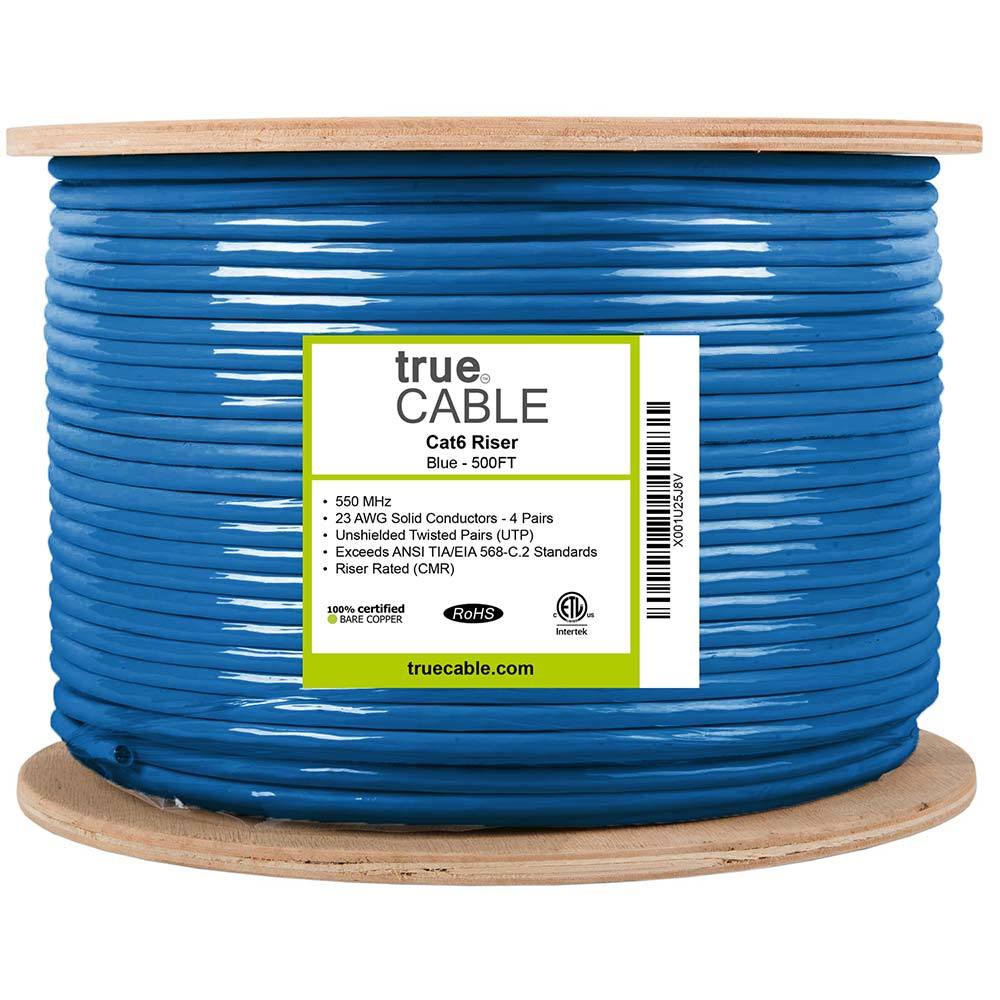
1000 ft riser-rated Cat6 bulk cable for in-wall structured cabling
Key details
- 23AWG solid bare copper conductors suitable for PoE and data runs
- CMR jacket and ETL listing for residential and commercial riser use

CMP-rated Cat6 bulk cable for true air-plenum pathways
Opens search results. Match the model and bundle before ordering.
Find options on AmazonOfficial specificationsKey details
- 23AWG solid bare copper conductors
- Lower-smoke jacket for commercial ceiling and raised-floor plenum use

Klein Tools
Klein Tools VDV526-100 LAN Cable Tester
A basic wiremap check for an accessible, disconnected Ethernet run when you can reach both ends.
Before you buy: Use only on unpowered cable with permission or after taking possession. It finds opens, shorts and miswires, but does not certify cable speed or replace a professional test report.
Key details
- Verifies pinout and continuity on Ethernet runs
- Remote terminator for one‑person testing
- Useful when validating new backhaul runs
CMP vs CMR checklist
- Identify the actual cable path before ordering bulk cable.
- Ask whether the route enters a true air-handling plenum or just a normal ceiling cavity.
- Use CMR as the normal indoor starting point unless the route specifically requires CMP.
- Use CMP when the route enters a plenum space or the project documents require it.
- Do not assume every suspended ceiling is a plenum.
- Do not assume plenum cable is faster; jacket rating and category rating are different decisions.
- Make the quote name jacket type and route assumptions clearly.
- Treat the local AHJ and actual building conditions as the final authority when there is doubt.
FAQs
Is plenum cable better than riser cable?
It is the higher indoor fire rating, but that does not automatically make it the better value. If the route is not a plenum, CMR is usually the more practical choice.
Does every drop ceiling require plenum cable?
No. A drop ceiling only requires plenum cable when that cavity is actually functioning as a plenum or the project requirements say it does.
Can I use CMR cable in my house?
Usually yes. In most single-family interior runs, CMR is the normal indoor default unless the route truly enters a plenum condition.
Can plenum cable replace riser cable?
In many cases yes, because it is the higher indoor rating. The practical question is whether paying for CMP everywhere makes sense for the actual route.
How do inspectors verify CMP or CMR during rough-in?
Inspectors typically read the jacket print legend on the installed cable and compare it with the pathway being used. Installers should leave visible markings so the rating can be confirmed without guesswork.
Why is plenum cable more expensive?
Because the jacket and internal materials are designed to meet stricter fire and smoke requirements for air-handling spaces. You are paying for the fire-rating performance, not extra network speed.
References
Plan the project with a site visit
Confirm wiring, equipment, placement, and installation scope before hardware is locked in.