

- Quick summary
- Reolink floodlight cameras compared
- Reolink TrackFlex Floodlight WiFi: best for driveways that need tracking
- Reolink Elite Floodlight WiFi: best for wide fixed coverage
- Reolink Solar Floodlight Cam: best for no-power zones
- Which Reolink floodlight camera should you buy
- Installation and power considerations
- FAQ
- References
Quick summary
The best Reolink floodlight camera for most homeowners is the TrackFlex Floodlight WiFi. It combines a 4K wide-angle view with a telephoto tracking lens in one body, giving you both context coverage and closer identification from a single mount point. Buy the Elite Floodlight WiFi when you want a wider 180-degree fixed panoramic view with stronger floodlights and no moving parts. Buy the Solar Floodlight Cam when the install location has no wired power and you need a budget-friendly wire-free option.
All three models record locally without a monthly subscription. The differences are power path, resolution, tracking capability, and how much light they put out.
- Best overall: Reolink TrackFlex Floodlight WiFi — dual-lens tracking with 4K wide and telephoto views.
- Best wide fixed coverage: Reolink Elite Floodlight WiFi — 180-degree panoramic view with 3000-lumen floodlights.
- Best wire-free: Reolink Solar Floodlight Cam — solar-powered with 1000-lumen adjustable light.
- All three support local recording with no mandatory monthly fee.
- Power path is the first decision: hardwired power opens up TrackFlex and Elite, no power limits you to Solar.
- Best Reolink cameras
- Exterior camera positioning and coverage guide
- Security camera system design guide
- NVR vs NAS vs cloud storage for camera footage
Reolink floodlight cameras compared
The three Reolink floodlight cameras serve different jobs. The comparison table below highlights the differences that matter most at install time.
| Feature | TrackFlex Floodlight WiFi | Elite Floodlight WiFi | Solar Floodlight Cam |
|---|---|---|---|
| Best for | Driveways and entries that need tracking and identification | Wide yards and perimeters that need fixed panoramic coverage | Sheds, fences, gates, and areas without wired power |
| Resolution | 4K dual-lens (wide + telephoto) | Dual-lens 180° panoramic stitched view | 4MP wide view |
| Tracking | Yes — auto-tracking with telephoto lens | No — fixed panoramic view | No — fixed view |
| Floodlight output | Up to 3000 lumens | Up to 3000 lumens | Up to 1000 lumens (adjustable) |
| Power | Hardwired (replaces existing floodlight) | Hardwired (replaces existing floodlight) | Solar panel with battery |
| Recording | 24/7 continuous or motion-triggered | 24/7 continuous or motion-triggered | Motion-triggered only |
| Network | Wi-Fi | Wi-Fi | Wi-Fi |
| Local storage | microSD, Home Hub, NVR | microSD, Home Hub, NVR | microSD, Home Hub |
| Typical price | About $234-$260 | About $195-$230 | About $99-$105 |
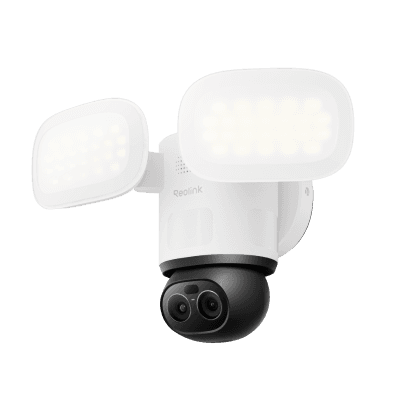
Wide driveway coverage with a closer tracking view, from one mounting point.
Before you buy: Requires wired power at the mounting point.
Key details
- Dual-lens floodlight camera with one 4K wide view and one tighter telephoto view
- 355-degree pan, 50-degree tilt, and AI auto tracking suit long driveways and moving subjects
- Hardwired power supports 24/7 recording without battery upkeep
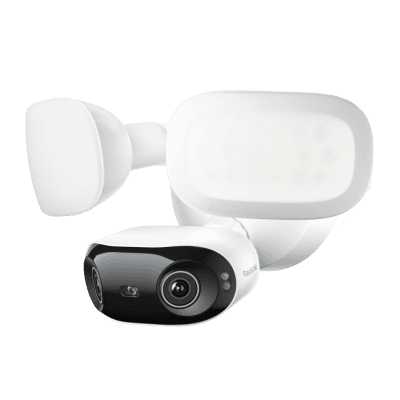
Wide, fixed coverage and floodlighting for yards and driveways.
Before you buy: Needs wired power and a reliable Wi-Fi signal.
Key details
- Fixed dual-lens floodlight camera with a 180-degree panoramic stitched view
- Up to 3000-lumen floodlights make it a strong driveway or yard deterrence camera
- Hardwired design and Wi-Fi 6 fit homes that have power but no Ethernet at the mount
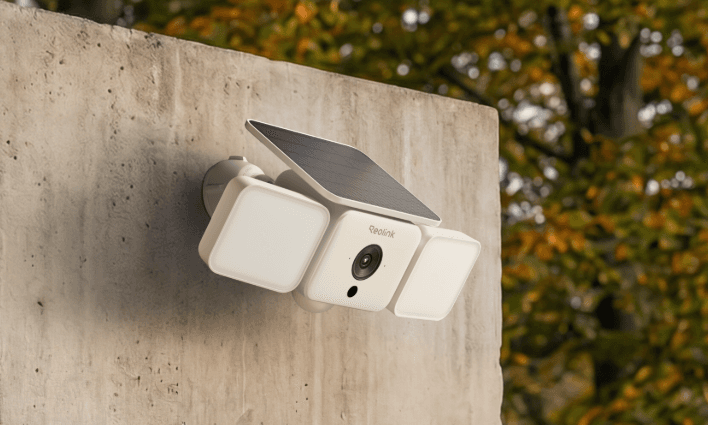
REOLINK
Reolink Solar Floodlight Cam
Add camera and floodlight coverage where running power is impractical.
Before you buy: Choose a position with suitable solar exposure.
Key details
- Wire-free floodlight camera with integrated solar charging and adjustable 1000-lumen lighting
- 4MP wide view works well for sheds, side yards, fences, and rental-friendly installs
- Good fit when wiring is the real constraint and you still want local storage with no subscription
Reolink TrackFlex Floodlight WiFi: best for driveways that need tracking
The Reolink TrackFlex Floodlight WiFi is the most feature-rich floodlight camera in the current Reolink lineup. It uses a dual-lens design with one 4K wide-angle view for context and one telephoto lens that auto-tracks movement for closer identification.
Wide driveway coverage with a closer tracking view, from one mounting point.
Before you buy: Requires wired power at the mounting point.
Key details
- Dual-lens floodlight camera with one 4K wide view and one tighter telephoto view
- 355-degree pan, 50-degree tilt, and AI auto tracking suit long driveways and moving subjects
- Hardwired power supports 24/7 recording without battery upkeep
Buy the TrackFlex when:
- The camera covers a driveway, front entry, or walkway where you need to identify who is approaching, not just see that someone is there.
- You want one camera that handles both wide context and tighter follow-up detail.
- You have hardwired power at the mount point — either an existing floodlight junction box or a new electrical run.
- You want 24/7 continuous recording, not just motion-triggered clips.
The dual-lens tracking is what makes the TrackFlex different from every other Reolink floodlight. The wide lens keeps the full scene in view while the telephoto lens follows movement across the field. That combination matters for driveways and approaches where you want to answer "who was that?" instead of just "something moved."
Skip the TrackFlex when:
- The camera position is a fixed overview where nobody approaches (like the back fence line). The Elite or a standard camera is cheaper and sufficient for static overview.
- There is no wired power at the mount point. The TrackFlex requires hardwired installation.
- You are on a tight budget. The TrackFlex costs more than the other two floodlight options, and the tracking lens is the reason.
For positioning guidance on driveways and front entries, the exterior camera positioning guide covers how to set up coverage zones and identification angles.
Reolink Elite Floodlight WiFi: best for wide fixed coverage
The Reolink Elite Floodlight WiFi is the right pick when you need wide panoramic coverage across a yard, driveway apron, or side of the house without auto-tracking.
Wide, fixed coverage and floodlighting for yards and driveways.
Before you buy: Needs wired power and a reliable Wi-Fi signal.
Key details
- Fixed dual-lens floodlight camera with a 180-degree panoramic stitched view
- Up to 3000-lumen floodlights make it a strong driveway or yard deterrence camera
- Hardwired design and Wi-Fi 6 fit homes that have power but no Ethernet at the mount
Buy the Elite when:
- You want a 180-degree stitched panoramic view that covers a wide area in a single camera.
- You want stronger floodlight output — up to 3000 lumens is noticeably brighter than the Solar Floodlight Cam and useful for deterrence.
- You want continuous 24/7 recording on hardwired power.
- You do not need auto-tracking — the goal is broad awareness, not close-up identification of individuals.
The Elite is the more practical choice for side-yard runs, backyard perimeters, and wide driveway aprons where the camera sits high and wide. The 180-degree stitched view captures more of the scene than a single standard lens, and the 3000-lumen floodlights give it a meaningful lighting advantage.
Skip the Elite when:
- You need to identify faces or read license plates. The fixed panoramic view is wide but not tight. For identification at range, the TrackFlex's telephoto lens is better.
- There is no wired power. The Elite requires the same hardwired install as the TrackFlex.
- You want the absolute lowest cost. The Solar Floodlight Cam is cheaper and works without wiring.
Reolink Solar Floodlight Cam: best for no-power zones
The Reolink Solar Floodlight Cam is the budget-friendly wire-free option for locations where pulling power is impractical or too expensive.
REOLINK
Reolink Solar Floodlight Cam
Add camera and floodlight coverage where running power is impractical.
Before you buy: Choose a position with suitable solar exposure.
Key details
- Wire-free floodlight camera with integrated solar charging and adjustable 1000-lumen lighting
- 4MP wide view works well for sheds, side yards, fences, and rental-friendly installs
- Good fit when wiring is the real constraint and you still want local storage with no subscription
Buy the Solar Floodlight Cam when:
- The install location has no existing wired power — sheds, detached garages, fences, gates, side alleys, and rental properties.
- You want a floodlight camera without any wiring project.
- Budget matters more than resolution or recording depth.
- You are comfortable with motion-triggered recording only, not 24/7 continuous.
The Solar Floodlight Cam uses integrated solar charging and battery power. That means no electrician, no junction box, and no conduit run. For locations that would otherwise have no camera at all, this is a genuine coverage upgrade at a low cost.
The limitations are real:
- 4MP resolution is noticeably lower than the 4K views on the TrackFlex and Elite. It is good enough for general awareness but not strong for detailed identification at range.
- Motion-triggered only. No continuous recording. If a slow-moving event does not trigger the motion sensor, it may not be captured.
- 1000-lumen floodlight is useful but visibly less bright than the 3000-lumen output on both the TrackFlex and Elite.
- Solar dependence. In shaded locations, heavy winter overcast, or north-facing walls, the solar panel may not charge enough to maintain consistent operation. This is a real concern in parts of Westchester and Fairfield County where shade from mature trees and steep roof overhangs can limit sun exposure.
Skip the Solar Floodlight Cam when you have access to power. If you can wire the location, the TrackFlex or Elite will give you better resolution, continuous recording, and stronger lighting.
Which Reolink floodlight camera should you buy
Use this decision flow:
| Your situation | Best pick | Why |
|---|---|---|
| Driveway or front entry, need to identify who is approaching | TrackFlex Floodlight WiFi | Dual-lens tracking gives both context and close-up identification |
| Wide yard, perimeter, or driveway apron, want broad awareness | Elite Floodlight WiFi | 180-degree panoramic view with strong 3000-lumen floodlights |
| Shed, fence, gate, or rental — no wired power available | Solar Floodlight Cam | Wire-free solar install, lowest cost, no electrician needed |
| Side of house with existing floodlight junction box, want best camera | TrackFlex Floodlight WiFi | Best image quality and tracking in a floodlight form factor |
| Back fence line, static overview only | Elite Floodlight WiFi | Wide fixed view at a lower price than TrackFlex |
| Detached garage or outbuilding with power | TrackFlex or Elite Floodlight WiFi | Either works — choose TrackFlex for tracking or Elite for wider view |
| Detached garage or outbuilding without power | Solar Floodlight Cam | Only wire-free option in the floodlight lineup |
For homeowners building a broader camera system, the best Reolink cameras guide covers the full lineup including non-floodlight options like the Duo 3 and Argus 4 Pro. If the front door also needs coverage, the Reolink Video Doorbell PoE vs WiFi comparison explains which doorbell model fits.
Installation and power considerations
The power path is the first question to answer before choosing a Reolink floodlight camera.
TrackFlex and Elite — hardwired install:
Both the TrackFlex and Elite replace an existing floodlight fixture or mount to a new junction box. The install typically requires:
- An existing outdoor floodlight junction box, or a new one run by an electrician.
- A stable Wi-Fi signal at the mount point. These cameras do not use PoE — they rely on Wi-Fi for the network connection and junction box power for the camera and floodlights.
- Mounting height that balances coverage and identification. Too high reduces detail; too low reduces the field of view.
The TrackFlex and Elite push continuous 4K dual-lens streams over Wi-Fi. That requires a strong, stable wireless signal at the exterior mount point. Before purchasing, test your Wi-Fi signal strength at the junction box location with a phone or tablet. If the signal is weak or intermittent there, the camera will drop frames or lose connection regardless of its specs. Adding a closer access point or a mesh node is usually a cheaper fix than troubleshooting a stuttering 4K stream after installation.
If the home already has floodlight fixtures on the driveway, garage, or side of the house, swapping in a TrackFlex or Elite is often straightforward. If there is no existing fixture, the electrical work is the bigger part of the project.
Solar Floodlight Cam — wire-free install:
The Solar Floodlight Cam mounts with screws and needs only a Wi-Fi signal. No electrician, no junction box, no conduit. The solar panel charges the battery, and the camera activates on motion.
The main install consideration is sun exposure. The solar panel needs consistent direct or indirect sunlight to keep the battery charged. Shaded walls, dense tree canopy, and north-facing surfaces can reduce charging enough to affect reliability, especially during shorter winter days.
For either path, if you want the system designed and installed professionally in Westchester or Fairfield County, our security surveillance services and Reolink installation page cover what a professional install includes. For guidance on pairing camera-mounted floodlights with ambient exterior lighting for cleaner night footage, the lighting strategies guide covers the principles.
FAQ
Which Reolink floodlight camera has the best image quality?
The TrackFlex Floodlight WiFi has the best image quality. Its dual-lens design provides a 4K wide view plus a telephoto tracking lens for closer identification. The Elite Floodlight WiFi has a strong 180-degree panoramic view but does not track. The Solar Floodlight Cam uses a 4MP sensor, which is lower than the other two.
Do Reolink floodlight cameras require a monthly subscription?
No. All three Reolink floodlight cameras — TrackFlex, Elite, and Solar Floodlight Cam — support local recording to microSD and Reolink Home Hub without a mandatory monthly fee. Optional Reolink Cloud is available in some regions but is not required.
Can the Solar Floodlight Cam record 24/7?
No. The Solar Floodlight Cam records motion-triggered clips only. Continuous 24/7 recording is available on the TrackFlex and Elite models because they use hardwired power.
How bright are Reolink floodlight cameras?
The TrackFlex Floodlight WiFi and Elite Floodlight WiFi both deliver up to 3000 lumens. The Solar Floodlight Cam provides up to 1000 lumens with adjustable settings.
Can I use Reolink floodlight cameras with a Reolink NVR?
The TrackFlex and Elite Floodlight WiFi can record to a Reolink NVR or Home Hub over the Wi-Fi network. The Solar Floodlight Cam supports Home Hub and microSD storage. The Home Hub vs Home Hub Pro vs NVR comparison explains which recorder fits which setup.
Does the Solar Floodlight Cam work in winter or cloudy conditions?
It can, but reduced sunlight affects charging. In locations with heavy shade, dense tree canopy, or extended overcast conditions, the solar panel may not charge the battery enough for consistent daily operation. Positioning the panel in a spot with the best available sun exposure helps.
References
- Reolink TrackFlex Floodlight WiFi official page — checked May 13, 2026
- Reolink Elite Floodlight WiFi official page — checked May 13, 2026
- Reolink Solar Floodlight Cam official page — checked May 13, 2026
Plan the project with a site visit
Confirm wiring, equipment, placement, and installation scope before hardware is locked in.