

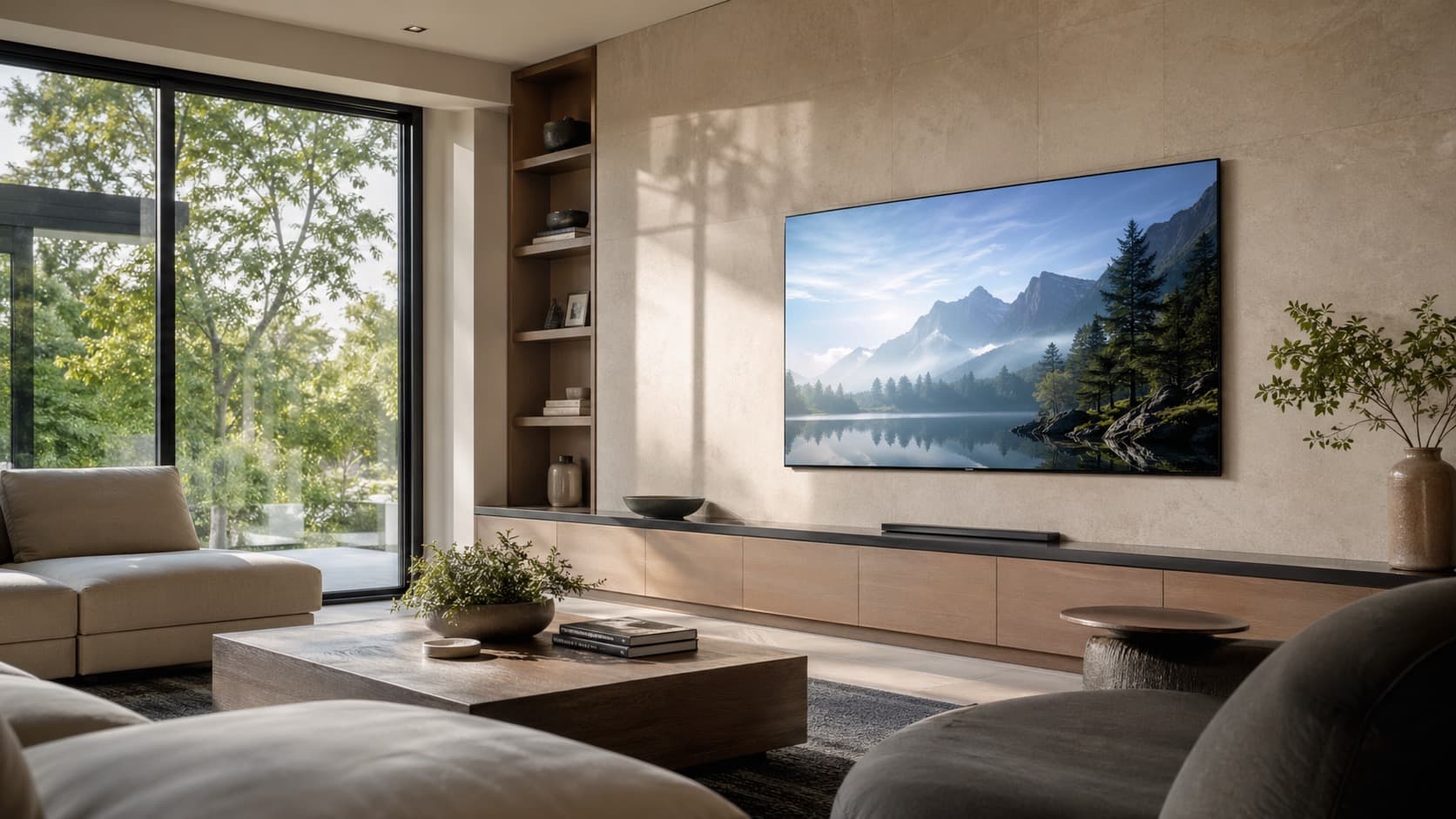
- Bottom line
- Why SDR brightness still matters for daytime TV
- Quick picks
- Which smart TV platform is easiest to live with?
- What TV features matter most in a bright room?
- How we assess glare in real rooms
- Samsung QN90F: The Best Overall TV for Bright Rooms
- Samsung S95F: The Best OLED TV for Bright Rooms
- Sony Bravia 9: The Best Premium Mini-LED TV for Bright Rooms
- TCL QM8K: The Best Large-Screen Value for Bright Rooms
- Hisense U8QG: The Best Bright-Room Value Pick
- LG G5: The Best OLED If You Can Control Reflections
- Setup rules that matter more than another 200 nits
- FAQs
- References
Bottom line
As of April 27, 2026, Mini-LED remains the most reliable choice for most bright rooms because it combines higher sustained brightness with fewer compromises during long daytime use. For most sunny living rooms, the Samsung QN90F is the best overall pick. If you want OLED in a bright room, the Samsung S95F is the leading current OLED option.
Updated for April 2026: We continue to test 2026 releases, but several 2025 models remain the top performers for glare reduction. Availability, sale pricing, and some gaming limits can vary by size.
- Buy the Samsung QN90F if you want the most dependable all-around TV for a bright family room.
- Buy the Samsung S95F if you want OLED and need stronger glare control than most OLEDs offer.
- Buy the Sony Bravia 9 if processing, motion, and off-axis comfort matter more than 165Hz gaming support.
- Buy the TCL QM8K or Hisense U8QG if size or value matters more than brand polish.
- Prioritize reflection handling first when windows face the screen, and sustained SDR brightness first when the room is bright but reflections are indirect.
Why SDR brightness still matters for daytime TV
SDR brightness matters because most daytime sports, news, cable boxes, and casual streaming still reach the TV as SDR rather than HDR.
A TV may produce an impressive HDR peak in a small test window and still look less effective than expected during daytime SDR viewing if its full-screen or sustained brightness is modest. For bright-room buyers, that means the headline spec is not always the one that best predicts how sports, cable news, or a multiview app will look at 2 p.m.
Mini-LED sets still hold the advantage here. They are generally better at sustaining bright full-screen images during long daytime sessions, which is one reason they remain the most dependable recommendation for all-day mixed use.
Before you blame the panel, confirm the room can actually deliver stable 4K streaming. High-bitrate HDR sports and live apps expose weak Wi-Fi quickly, so a bright-room TV plan should also account for wired vs. wireless network design or at least solid gigabit internet and streamer planning.
For larger homes or rooms at the edge of coverage, a hardwired streaming box or game console is still the cleanest answer. If the room depends on wireless, we generally prefer a properly placed enterprise-grade access point such as a UniFi design with right-sized access-point placement over relying on a weak ISP router in another part of the house.
Quick picks
| Model | Panel | Reflection technology | Approx. measured HDR peak | Gaming ceiling | Best fit |
|---|---|---|---|---|---|
| Samsung QN90F | Neo QLED / Mini-LED | Samsung Glare Free | ~2,086 nits | Up to 4K/165 with supported PC titles | Sunny family rooms, sports, all-day mixed use |
| Samsung S95F | QD-OLED | Samsung Glare Free | ~2,132 nits | Up to 4K/165 with supported PC titles | Buyers who want OLED in a bright room |
| Sony Bravia 9 | Mini-LED QLED | X-Anti Reflection + X-Wide Angle | ~2,280 nits | 4K/120 | Premium bright rooms with wider seating |
| TCL QM8K | QD-Mini LED | CrystGlow WHVA / anti-reflective panel | ~3,648 nits | 4K/144 | 85-inch class value in bright rooms |
| Hisense U8QG | Mini-LED | Low-reflection / anti-glare panel focus | ~3,384 nits | Up to 4K/165 | Best value if you want maximum output for the money |
| LG G5 | OLED evo | Glossy OLED with Brightness Booster Ultimate | ~2,268 nits | VRR up to 165Hz | Bright rooms with some light control and stronger movie priorities |
Approximate HDR values above reflect public review testing published as of April 2026. They are useful comparison points, but they are not a single-lab apples-to-apples dataset.
Start with these four unless you specifically need an 85-inch value play or a glossy OLED for a room with better light control.
Glare Free Mini-LED is the safest all-day bright-room choice in this guide
Key details
- About 2,000-nit-class HDR with stronger sustained daytime punch than OLED
- Up to 4K/165 for PC gaming, with a better sports-and-news fit than most OLEDs
Glare Free QD-OLED is the easiest OLED here to live with in daytime rooms
Key details
- Roughly 2,100-nit-class HDR output with wide viewing angles
- Up to 4K/165 for PC play, with a matte finish that looks less glossy at night
Best processing choice here for cable, sports, and mixed streaming
Key details
- Premium Mini-LED with X-Anti Reflection, X-Wide Angle, and strong off-axis comfort
- 4K/120 is the gaming tradeoff versus Samsung's 165Hz ceiling
Best output-per-dollar bright-room option in this lineup
Key details
- Roughly 3,300-nit-class HDR output with native 165Hz support
- Excellent value if you can accept less polish than Samsung or Sony
Which smart TV platform is easiest to live with?
Samsung's Tizen platform is usually fast and straightforward for buyers who want a clean home screen and quick access to the major apps. Google TV, used by Sony, Hisense, and TCL, generally offers the broadest content discovery and casting flexibility, while LG webOS tends to feel simple and stable for day-to-day use with good app support and a clean pointer-style remote workflow.
If the TV will be part of a broader control system, platform fit matters beyond the app row. Samsung often suits SmartThings-heavy homes, Google TV fits naturally in Google-centric households, and LG webOS is a practical middle ground for buyers who want a polished TV interface without building the room around one ecosystem.
What TV features matter most in a bright room?
Anti-glare coatings, peak HDR brightness above roughly 1,500 nits, and stable off-axis viewing are the three features that matter most in a bright room.
Brightness alone is not enough. A room with side daylight is easier than a room with windows directly opposite the screen, and a room used mostly for daytime sports has different requirements than a room that becomes a movie space after dark.
- If windows or lamps reflect directly across from the screen, prioritize screen finish and reflection handling first.
- If the room is bright but reflections are not directly hitting the panel, raw brightness and local dimming matter more than a matte coating.
- If the seating spreads wide across a sectional, viewing angle matters almost as much as brightness.
- If the TV runs all day for news, sports, and casual streaming, Mini-LED is still the more dependable category.
- If the room also becomes a darker movie room at night, OLED can still be the better answer if glare is under control.
A matte screen reduces sharp reflections, but it can make black levels look slightly hazier in daylight than a glossy OLED. A glossy screen usually looks richer at night, but it will show windows and lamps more clearly during the day.
We plan TVs as part of the room, not as isolated products. Mount height, window placement, off-axis seats, soundbar clearance, and cable paths all affect the result. If the room has a large uncovered window opposite the screen, automated shades can improve daytime viewing more than moving from one premium TV to another; the broader glare-control side of that fix is covered in our smart home automation lighting and shades guide.
- Balanced living room TV planning
- TV mounting height and power relocation
- Home media wall setup and cable management
- Outdoor TV installation for patios and covered porches
- Projector vs TV for light-controlled rooms
How we assess glare in real rooms
We assess glare from the main seat in daytime conditions, not from the spec sheet alone.
Our field check is simple:
- Stand at the primary seat with shades open during the brightest practical part of the day.
- Note whether windows and lamps appear as sharp reflections or only as diffuse haze.
- Check one or two off-axis seats, not just the center cushion.
- Compare the client's actual mix of daytime SDR content and evening HDR content.
This method is less scientific than a lab measurement, but it is often more useful for purchase decisions because it exposes the problem the owner is actually trying to solve.
Samsung QN90F: The Best Overall TV for Bright Rooms
The Samsung QN90F is the best overall bright-room TV because it combines a Mini-LED backlight with Samsung's Glare Free screen treatment.
Samsung's U.S. product page for the 65-inch QN90F lists Glare Free, Neo Quantum HDR+, and Motion Xcelerator 165Hz. Public review testing published in April 2026 places its peak HDR brightness at roughly 2,086 nits, which is enough output for difficult living rooms without requiring buyers to move to a much larger or more expensive flagship.
For all-day mixed use, this is the most reliable choice in the group. It suits sports, news, streaming, and gaming in rooms where reflections are a consistent issue. The 165Hz figure should be treated as an upper-end PC-gaming ceiling, not as the number most console buyers will use every day, but it is still relevant for buyers who connect a capable PC.
- Best glare-control choice for all-day living rooms
- Strong daytime SDR and HDR performance for sports and news
- Up to 4K/165Hz support is most useful for PC gamers
Check current pricing below before buying, since Samsung sale pricing moves often.
Glare Free Mini-LED is the safest all-day bright-room choice in this guide
Key details
- About 2,000-nit-class HDR with stronger sustained daytime punch than OLED
- Up to 4K/165 for PC gaming, with a better sports-and-news fit than most OLEDs
Samsung S95F: The Best OLED TV for Bright Rooms
The Samsung S95F is the best OLED TV for bright rooms because it pairs OLED contrast and wide viewing angles with Samsung's Glare Free coating.
Samsung's official S95F pages for the 55-, 65-, 77-, and 83-inch models all list Motion Xcelerator 165Hz, OLED HDR Pro, and Glare Free. Public review testing published in April 2026 places the S95F around 2,132 nits in peak HDR, which is unusually strong for an OLED that is also designed specifically to reduce daytime reflections.
The tradeoff remains visible. Matte glare control helps in bright rooms, but it also softens the glossy "ink on glass" look that many movie-focused OLED buyers still prefer in darker spaces. If reflections are the larger problem, the S95F is the better OLED fit. If light control is already good, the LG G5 can still be the more cinematic-looking OLED at night.
- Best OLED choice when reflections are the main problem
- Wide viewing angles help across larger sectionals
- Matte finish trades some glossy depth for better daytime comfort
Glare Free QD-OLED is the easiest OLED here to live with in daytime rooms
Key details
- Roughly 2,100-nit-class HDR output with wide viewing angles
- Up to 4K/165 for PC play, with a matte finish that looks less glossy at night
If you are still weighing long-term OLED ownership tradeoffs, the separate LG OLED burn-in mitigation guide is the right companion read.
Sony Bravia 9: The Best Premium Mini-LED TV for Bright Rooms
The Sony Bravia 9 is the best premium Mini-LED TV for bright rooms because it combines strong brightness with better processing and seating flexibility than most bright-room rivals.
Sony describes the Bravia 9 as its brightest 4K TV ever and highlights X-Wide Angle plus X-Anti Reflection in its official materials. Public testing published in 2026 commonly places its HDR peak around the mid-2,000-nit range, and major U.S. retailer pricing for the 65-inch was running about $1,998 to $1,999 on April 27, 2026.
This is the premium pick for buyers who watch a lot of sports, broadcast TV, and mixed-quality streaming and care about motion handling as much as brightness. Sony's image processing still tends to be especially useful with low-bitrate cable channels and inconsistent streaming sources. The tradeoff is simple: gaming support tops out at 4K/120, so buyers who prioritize the highest PC-gaming ceiling should look elsewhere.
- Best processing choice for cable, sports, and mixed streaming
- Better off-axis comfort than many bright-room rivals
- 4K/120 is the main compromise versus Samsung
Best processing choice here for cable, sports, and mixed streaming
Key details
- Premium Mini-LED with X-Anti Reflection, X-Wide Angle, and strong off-axis comfort
- 4K/120 is the gaming tradeoff versus Samsung's 165Hz ceiling
TCL QM8K: The Best Large-Screen Value for Bright Rooms
The TCL QM8K is the best large-screen value for bright rooms because it offers very high brightness without pushing buyers into flagship OLED pricing.
TCL's official materials describe the QM8K with up to HDR5000 Brightness, 144Hz native refresh, and its CrystGlow WHVA panel. Public review testing published in 2026 places the 85-inch class QM8K around 3,648 nits in accurate HDR settings, which puts it among the brightest sets in this article.
That makes QM8K especially useful in 75- and 85-inch shopping. Bright rooms often reward a larger screen because daylight reduces apparent contrast and image authority. TCL does not match Sony or Samsung for processing and overall polish, but it remains one of the most practical ways to buy a very large bright-room TV without moving directly into flagship pricing.
- Strong 85-inch value for daylight-heavy rooms
- Very high HDR output for the price tier
- Processing still trails Sony and Samsung
Best 85-inch bright-room pick when size matters as much as panel quality
Key details
- Around 3,600-nit-class HDR with an anti-reflective wide-angle screen
- 4K/144 and huge screen value, though processing trails Samsung and Sony
Hisense U8QG: The Best Bright-Room Value Pick
The Hisense U8QG is the best bright-room value pick because it delivers unusually high light output for the money.
Hisense's official product materials highlight MiniLED Pro and 165Hz gaming support, and public review testing published in 2026 commonly places the U8QG in the mid-3,000-nit range for peak HDR. That is enough output to put it in direct contention with more expensive bright-room sets.
The tradeoff is refinement. Hisense is still less polished than Sony at motion and less predictable than Samsung at overall processing. For buyers who care first about output and price, that may be an acceptable compromise.
- Highest output-per-dollar pick in the group
- Strong gaming fit without premium-brand pricing
- Best when brightness matters more than polish
Best output-per-dollar bright-room option in this lineup
Key details
- Roughly 3,300-nit-class HDR output with native 165Hz support
- Excellent value if you can accept less polish than Samsung or Sony
LG G5: The Best OLED If You Can Control Reflections
The LG G5 is the best OLED for bright rooms that have some light control because it delivers flagship OLED brightness without moving to a matte screen.
LG's consumer-facing product materials describe the G5 as Bright Room Ready and emphasize Brightness Booster Ultimate with VRR up to 165Hz. That is the language that belongs in the published article. LG's own retail messaging is centered on OLED evo brightness rather than panel-architecture terminology.
Public review testing published in 2026 places the G5 around 2,268 nits in peak HDR, which is strong enough for many bright rooms. The difference versus the S95F is straightforward: the G5 is the better fit when you can control reflections reasonably well and want a glossy, cinema-first OLED image. The S95F is the better fit when glare reduction is the higher priority.
- Best glossy OLED option when glare is manageable
- Better fit than the S95F for movie-first buyers
- Strong match for flush-mount media walls
Best glossy OLED pick if the room has at least some reflection control
Key details
- Around 2,250-nit-class HDR with Brightness Booster Ultimate
- Movie-first gallery OLED with VRR up to 165Hz and an included wall mount
If the wall and cable path matter as much as the panel, request a clean TV and audio install.
Setup rules that matter more than another 200 nits
A better TV does not correct a poor placement plan.
In bright rooms, these setup decisions often matter more than a small spec advantage:
- Avoid placing the screen directly opposite uncovered windows if the room gives you any other wall option.
- Leave vertical space for a soundbar or center channel before you lock mount height.
- Save separate daytime and nighttime picture presets. The right daytime mode is usually brighter and less purist than your evening movie mode.
- If you want a near-flush install, plan recessed power and low-voltage before the bracket goes up.
- Bigger is often the better bright-room answer. Daylight reduces the apparent impact of smaller screens more than buyers expect.
The mount, recessed power, and certified HDMI path usually matter more than buyers think. They do not make the image brighter, but they make the room easier to live with.
Low-profile tilt mount sized for common living-room and fireplace TV installs
Key details
- Universal design for 42-inch to 90-inch TVs with included hardware
- Better fit than a fixed mount when the screen lands slightly high
Recessed in-wall power kit for cleaner TV installations
Key details
- Pairs line-voltage power relocation with a low-voltage cable path strategy
- Useful when the TV location needs a cleaner finish than a surface cord drop
Ultra High Speed HDMI certified for current HDMI 2.1 feature sets
Key details
- 2-meter length fits common TV-to-soundbar or TV-to-cabinet runs
- Supports 4K120, 8K60, VRR, and eARC when the rest of the chain is correct
FAQs
Is OLED or Mini-LED better for bright rooms?
Mini-LED is better for most bright rooms because it usually provides higher sustained brightness and fewer limitations during long daytime use. OLED becomes the better choice when you also care deeply about movie-night contrast and either have some light control or choose an OLED with unusually strong glare management, such as the Samsung S95F.
Is the Samsung S95F better than the QN90F for a sunny room?
Not automatically. The QN90F is the more dependable overall answer for the more reflective room. The S95F is the better answer when you want OLED and need better glare handling than most OLEDs provide.
Do anti-glare coatings matter more than peak brightness?
In rooms with direct reflections, yes. More brightness helps, but it does not erase a mirror-like reflection from a window opposite the screen. That is why reflection handling can matter more than raw nits in the most difficult layouts.
Does 165Hz matter on these TVs?
It matters mainly for PC gamers with compatible hardware and supported games. Most console buyers will still spend most of their time at 4K/120, so glare handling and overall image quality should matter more than chasing the highest refresh number alone.
Should I buy a 2025 model TV in 2026?
Yes, if it is still current, supported, and competitively priced. As of April 27, 2026, several of the best bright-room TVs widely available in the U.S. are still 2025-model sets. Buying by room fit is smarter than buying by model year alone.
What size TV works best in a bright living room?
Most bright living rooms benefit from going larger than buyers first expect. Daylight reduces apparent contrast and image authority, so a 75-inch or 85-inch set often feels more comfortable than a smaller premium display. Just confirm sightlines, wall width, and room for audio before finalizing the size.
References
Plan the TV, sound and wiring with a site visit
Walk the room with us to settle TV height, speaker placement and where the cables and equipment will go before anything is installed.