


- Quick summary
- What Is the Best Roku and Sonos Starter Stack?
- Why Choose Roku Ultra Instead of Apple TV 4K for This Stack?
- Which Roku and Sonos Hardware Fits Each Room Best?
- How to Prepare Your Home Network for Roku and Sonos
- Configuring HDMI eARC for Lossless Audio
- Best Control Strategy for Roku and Sonos Systems
- How to Dial In Sonos for TV and Music
- How Does Quiet Mode with Sonos Ace Work?
- Common Roku and Sonos Troubleshooting Steps
- What Should Go on the Quick-Start Card?
- How Should You Maintain the Stack Over Time?
- FAQs
- References
Quick summary
Use Roku Ultra with Sonos Arc Ultra in the main room, wire the fixed gear, and keep daily control on one Roku remote.
- Main-room pick: Roku Ultra plus Sonos Arc Ultra gives you the cleanest premium starter stack for a shared TV space.
- Smaller-room pick: Beam (Gen 2) keeps the Sonos experience simpler and more cost-effective for bedrooms and secondary TVs.
- Reliability rule: hardwire stationary gear first, then use MoCA or quality Wi-Fi only where wiring is truly impractical.
- Control rule: one Roku remote should handle TV power, app launching, and soundbar volume through HDMI-CEC.
- Handoff rule: label inputs, document the remote location, and leave a printed quick-start card behind.
What Is the Best Roku and Sonos Starter Stack?
Roku Ultra plus Sonos Arc Ultra is the cleanest premium starter stack for a shared TV room.
Roku Ultra gives you Roku's fastest interface, Ethernet, Wi-Fi 6, Dolby Vision, Dolby Atmos, and direct Bluetooth headphone pairing for private listening. Sonos Arc Ultra gives you the current flagship Sonos TV-audio path over one HDMI eARC connection. In smaller rooms, keep the same control logic and step down to Beam (Gen 2) or a simpler Sonos speaker zone.
| Room | Streamer | Audio | Best fit | Why it works |
|---|---|---|---|---|
| Main living room | Roku Ultra | Arc Ultra | Large shared TV rooms | Fast interface, one-remote control path, strongest Sonos soundbar option |
| Smaller TV room | Roku Express 4K+ | Beam (Gen 2) | Bedrooms, dens, guest TVs | Lower cost, smaller footprint, still easy to hand off |
| Music-first open room | Roku Ultra or no TV streamer | Era 300 pair or Amp-driven speakers | Open kitchens, great rooms, flex spaces | Better music coverage than forcing every room into a soundbar |
Roku’s fastest player (30% faster than other Roku players)
Key details
- 802.11ax dual-band Wi-Fi 6 plus Ethernet
- Dolby Vision, HDR10+, and Dolby Atmos support
Sound Motion technology for deeper bass and cleaner output in premium TV rooms
Key details
- Quick Tuning on iOS or Android, plus Advanced Tuning on supported iOS devices
- 9.1.4 Dolby Atmos soundbar with HDMI eARC
Virtualized Dolby Atmos with five-driver array
Key details
- HDMI eARC with CEC volume control
- Full Trueplay tuning requires a supported iPhone or iPad
Why Choose Roku Ultra Instead of Apple TV 4K for This Stack?
Choose Roku Ultra when simple daily use matters more than deep Apple ecosystem features.
We specify Roku Ultra for mixed-device households because the interface is easier to hand off, the remote workflow is straightforward, and the platform stays neutral across iPhone and Android homes. Apple TV 4K is still an excellent streamer, but it makes more sense when the house already depends on Apple services such as FaceTime on TV, HomePods, or tighter Apple account integration.
Which Roku and Sonos Hardware Fits Each Room Best?
Use Arc Ultra for larger shared rooms, Beam (Gen 2) for smaller TV spaces, and Amp or Era speakers when the room is music-first.
| Product | Current role | Best room | Why choose it | Watch for |
|---|---|---|---|---|
| Roku Ultra | Primary premium streamer | Main TV room | Ethernet, Wi-Fi 6, fastest Roku interface, Bluetooth headphone mode | Best when the TV area can be wired |
| Roku Express 4K+ | Lower-cost room add-on | Secondary TVs | Keeps Roku consistent without paying for every flagship feature | Less ideal for the busiest main room |
| Sonos Arc Ultra | Flagship Sonos soundbar | Larger living rooms and media spaces | Stronger output, Sound Motion, better fit for bigger screens | Needs open placement and proper eARC setup |
| Sonos Beam (Gen 2) | Compact Sonos TV bar | Bedrooms, dens, smaller family rooms | Smaller footprint, simpler value story, still supports eARC and TV Audio Swap | Will not fill larger open rooms as confidently as Arc Ultra |
| Sonos Era 300 | Music-first or surround add-on | Open rooms and premium surround duty | Better for spatial music and rear-surround duty than forcing a second soundbar | Not a substitute for a soundbar under a main TV |
| Sonos Amp | Passive-speaker zone driver | In-ceiling, outdoor, or architectural speaker zones | Clean fit when the room already wants passive speakers | Requires speaker wiring and a real equipment location |
How to Prepare Your Home Network for Roku and Sonos
Wire stationary devices like TVs, Roku boxes, and fixed Sonos gear whenever possible.
Start with the TV area, Roku Ultra, and any fixed Sonos hardware. If direct Ethernet is not practical, use MoCA over existing coax before you trust a weak mesh hop for the primary media room. Keep access points out of cabinetry, avoid putting controller devices on guest SSIDs, and keep the Sonos app devices on the same main network as the speakers.
For planning, budget around 25 Mbps of real downstream bandwidth per active 4K room even though many services can run at lower rates. That extra headroom matters when other devices are downloading updates, cloud backups are running, or multiple rooms are streaming at once.
For managed-switch installs, validate STP and multicast behavior before handoff. In real homes, Sonos failures usually come from bad switching, guest-network isolation, weak mesh backhaul, or wrong-subnet controller devices, not from a lack of headline internet speed.
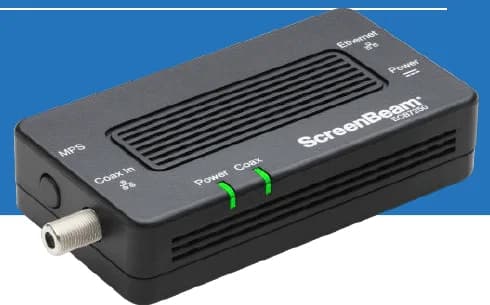
A two-adapter option for wired backhaul when a usable coax path already connects the router area and a weak room.
- 2 adapters in kit
- 2.5GbE port per adapter
- Uses existing coax
Before you buy: Confirm both outlets share a compatible coax system. Satellite and some provider setups are incompatible; DOCSIS 3.1 can conflict. Check splitters and any required point-of-entry filter before buying.
Configuring HDMI eARC for Lossless Audio
Connect the Roku to a regular TV HDMI input, then connect the Sonos soundbar to the TV's eARC port.
- 1Connect Roku Ultra to a standard TV HDMI input.
- 2Connect Arc Ultra or Beam (Gen 2) to the TV's HDMI eARC or ARC port.
- 3Enable eARC and HDMI-CEC in the TV settings, then disable the internal TV speakers.
- 4Confirm the TV is passing the expected audio format back to Sonos before you add more sources.
| Device | Connect to | Why this path is correct |
|---|---|---|
| Roku Ultra | Any regular TV HDMI input | The TV remains the switching point for apps and any additional sources. |
| Sonos Arc Ultra or Beam (Gen 2) | TV HDMI eARC or ARC port | The TV returns sound to Sonos over one consistent audio path. |
| Optional backhaul | Ethernet or MoCA to the TV area | Wired backhaul reduces the chance that Wi-Fi instability gets blamed on HDMI or Sonos. |
If audio starts as stereo PCM when you expect Atmos or multichannel playback, fix the TV's eARC and digital-audio settings first. That is faster than troubleshooting from the Sonos side after the room is already in service.
Best Control Strategy for Roku and Sonos Systems
Use one Roku remote for daily control and treat voice assistants as optional shortcuts.
Most households do best when one remote powers the TV, launches apps, and changes soundbar volume through HDMI-CEC. Voice assistants can still be useful for quick commands, but they should not be the only way to start playback or recover from a simple user mistake.
- Pick one Roku remote as the everyday remote and label where it lives.
- Label each TV input with the real source name before handoff.
- Keep spare charging cables or batteries in the same room as the remote.
- Do not require a second remote unless the room truly has a second daily-use source.
Rechargeable via USB-C with hands-free “Hey Roku”
Key details
- Backlit buttons with customizable shortcuts
- No headphone jack; private listening uses Roku mobile app or Bluetooth audio
How to Dial In Sonos for TV and Music
Run Trueplay, confirm TV AutoPlay, and test lip sync across every source before you leave.
Once the HDMI path is stable, tune the Sonos room properly. Run Trueplay for the finished furniture layout, confirm TV AutoPlay is behaving correctly, and test streaming apps, game consoles, and Blu-ray sources separately. If the room is too large for a soundbar alone, add Era 300 surrounds or move architectural zones to Sonos Amp rather than just raising volume.
Minor lip-sync problems should be corrected before the system is handed off. If dialogue is late or early, adjust the TV or Sonos delay settings while the room is quiet and someone is watching the screen from the primary seats.
Six-driver array with side and upward-firing drivers for Dolby Atmos music
Key details
- Wi-Fi 6, Bluetooth 5.3, and line-in support
- Quick Tuning on iOS and Android, plus Advanced Tuning on supported iOS devices

A supportable amplifier for a wired patio speaker zone when the household already uses Sonos or wants app-based control.
Before you buy: This is one stereo zone, not independent patio and pool control. Confirm a protected location, speaker compatibility and cable routes before ordering.
Key details
- 125 W per channel into 8 ohms for architectural speakers
- HDMI ARC input for TV audio integration
- Sonos app control and multiroom playback with compatible Sonos products
How Does Quiet Mode with Sonos Ace Work?
TV Audio Swap lets a compatible Sonos soundbar send TV sound to one or two Sonos Ace headphones.
This is useful when the room needs to go quiet without changing the main control flow. Set it up in the Sonos app, keep Wi-Fi enabled on the home theater speaker, and test it before handoff so the client knows where the swap command lives.
Active Noise Cancellation with spatial audio support
Key details
- TV Audio Swap with compatible Sonos soundbars
- Up to two Ace headphones can share TV Audio Swap
Sound Motion technology for deeper bass and cleaner output in premium TV rooms
Key details
- Quick Tuning on iOS or Android, plus Advanced Tuning on supported iOS devices
- 9.1.4 Dolby Atmos soundbar with HDMI eARC
Common Roku and Sonos Troubleshooting Steps
Fix audio first, then fix control, then work backward to network and heat.
- No audio: Verify the soundbar is on the TV's eARC port, confirm eARC is enabled, and disable the TV's internal speakers.
- Lip-sync drift: Test one source at a time and adjust audio delay in the TV or Sonos app only after the HDMI path is confirmed.
- App crashes or a frozen interface: Reboot the Roku, then check for Roku OS and app updates before blaming the network.
- Intermittent dropouts: Check ventilation, cabinet heat, and weak Wi-Fi before replacing cables. Overheated gear often looks like a network problem.
- Remote confusion: Re-label the remote location and input names. Many "system issues" are really handoff failures.
We troubleshoot Roku, Sonos, HDMI, and in-room network problems in the field, then leave the room with a cleaner control path than it started with.
What Should Go on the Quick-Start Card?
A one-page quick-start card should tell the room owner which remote to use and what to do first.
- Primary remote name and where it lives
- How to launch the main streaming apps
- How to switch to a game console or Blu-ray player
- What to do if there is no sound or the wrong input is active
- Where spare cables, chargers, and support contact details are stored
The quick-start card should match the TV's actual input labels and the room's real control flow. If the room has multiple users, run a two-minute handoff with them before you leave and correct anything that feels unclear.
How Should You Maintain the Stack Over Time?
Recheck the room quarterly so software updates and furniture changes do not quietly break the experience.
Review Roku OS updates, re-run Trueplay if the room layout changed, refresh expired streaming logins, and clean dust from shelves, vents, and cabinet fans. Keep a short service log with remote replacements, network changes, and source swaps so the next visit starts from facts instead of guesswork.
FAQs
Do I need a receiver with Sonos?
Not in most rooms. A Sonos soundbar plus optional surrounds or sub handles TV audio cleanly without the complexity of a full AVR.
Should Roku be wired?
Yes, when possible. A wired Roku reduces buffering risk and makes control and sync issues easier to isolate.
Can a Roku remote control Sonos volume?
Yes. When the TV and Sonos soundbar are configured correctly with HDMI-CEC and eARC or ARC, the Roku remote can usually handle daily volume control.
Is Beam (Gen 2) still the current Beam?
Yes. As of March 16, 2026, Sonos is still selling Beam (Gen 2), so this guide does not speculate about unreleased Beam hardware.
References
Plan the project with a site visit
Confirm wiring, equipment, placement, and installation scope before hardware is locked in.